
一、使用命令行工具创建RBAC对象
1.1 创建Role
1.创建名称为 “pod-reader” 的 Role 对象,允许用户对 Pods 执行 get、watch 和 list 操作
$ kubectl create role pod-reader --verb=get --verb=list --verb=watch --resource=pods
2.创建名称为 “pod-reader” 的 Role 对象并指定 resourceNames
$ kubectl create role pod-reader --verb=get --resource=pods --resource-name=readablepod --resource-name=anotherpod
3.创建名为 “foo” 的 Role 对象并指定 apiGroups
$ kubectl create role foo --verb=get,list,watch --resource=replicasets.apps
4.创建名为 “foo” 的 Role 对象并指定子资源权限
$ kubectl create role foo --verb=get,list,watch --resource=pods,pods/status
5.创建名为 “my-component-lease-holder” 的 Role 对象,使其具有对特定名称的资源执行 get/update 的权限
$ kubectl create role my-component-lease-holder --verb=get,list,watch,update --resource=lease --resource-name=my-component
1.2 创建ClusterRole
1.创建名称为 “pod-reader” 的 ClusterRole 对象,允许用户对 Pods 对象执行 get、 watch 和 list 操作
$ kubectl create clusterrole pod-reader --verb=get,list,watch --resource=pods
2.创建名为 “pod-reader” 的 ClusterRole 对象并指定 resourceNames
$ kubectl create clusterrole pod-reader --verb=get --resource=pods --resource-name=readablepod --resource-name=anotherpod
3.创建名为 “foo” 的 ClusterRole 对象并指定 apiGroups
$ kubectl create clusterrole foo --verb=get,list,watch --resource=replicasets.apps
4.创建名为 “foo” 的 ClusterRole 对象并指定子资源
$ kubectl create clusterrole foo --verb=get,list,watch --resource=pods,pods/status
5.创建名为 “foo” 的 ClusterRole 对象并指定 nonResourceURL
$ kubectl create clusterrole "foo" --verb=get --non-resource-url=/logs/*
6.创建名为 “monitoring” 的 ClusterRole 对象并指定 aggregationRule:
$ kubectl create clusterrole monitoring --aggregation-rule="rbac.example.com/aggregate-to-monitoring=true"
1.3 创建RoleBinding
1.在名字空间 “acme” 中,将名为 admin 的 ClusterRole 中的权限授予名称 “bob” 的用户
$ kubectl create rolebinding bob-admin-binding --clusterrole=admin --user=bob --namespace=acme
2.在名字空间 “acme” 中,将名为 view 的 ClusterRole 中的权限授予名字空间 “acme” 中名为 myapp 的服务账户
$ kubectl create rolebinding myapp-view-binding --clusterrole=view --serviceaccount=acme:myapp --namespace=acme
3.在名字空间 “acme” 中,将名为 view 的 ClusterRole 对象中的权限授予名字空间 “myappnamespace” 中名称为 myapp 的服务账户
$ kubectl create rolebinding myappnamespace-myapp-view-binding --clusterrole=view --serviceaccount=myappnamespace:myapp --namespace=acme
1.4 创建ClusterRoleBinding
1.在整个集群范围,将名为 cluster-admin 的 ClusterRole 中定义的权限授予名为 “root” 用户:
$ kubectl create clusterrolebinding root-cluster-admin-binding --clusterrole=cluster-admin --user=root
2.在整个集群范围内,将名为 system:node-proxier 的 ClusterRole 的权限授予名为 “system:kube-proxy” 的用户
$ kubectl create clusterrolebinding kube-proxy-binding --clusterrole=system:node-proxier --user=system:kube-proxy
3.在整个集群范围内,将名为 view 的 ClusterRole 中定义的权限授予 “acme” 名字空间中名为 “myapp” 的服务账户
$ kubectl create clusterrolebinding myapp-view-binding --clusterrole=view --serviceaccount=acme:myapp
1.5 创建或者更新 API 对象
使用清单文件来创建或者更新 rbac.authorization.k8s.io/v1 API 对象。
尚不存在的对象会被创建,如果对应的名字空间也不存在,必要的话也会被创建。 已经存在的角色会被更新,使之包含输入对象中所给的权限。如果指定了 --remove-extra-permissions,可以删除额外的权限。
已经存在的绑定也会被更新,使之包含输入对象中所给的主体。如果指定了 --remove-extra-permissions,则可以删除多余的主体。
1.测试应用 RBAC 对象的清单文件,显示将要进行的更改
$ kubectl auth reconcile -f my-rbac-rules.yaml --dry-run=client
2.应用 RBAC 对象的清单文件,保留角色(roles)中的额外权限和绑定(bindings)中的其他主体
$ kubectl auth reconcile -f my-rbac-rules.yaml
3.应用 RBAC 对象的清单文件,删除角色(roles)中的额外权限和绑定中的其他主体
$ kubectl auth reconcile -f my-rbac-rules.yaml --remove-extra-subjects --remove-extra-permissions
二、聚合ClusterRole
你可以将若干 ClusterRole 聚合(Aggregate) 起来,形成一个复合的 ClusterRole。 作为集群控制面的一部分,控制器会监视带有 aggregationRule 的 ClusterRole 对象集合。aggregationRule 为控制器定义一个标签选择算符供后者匹配应该组合到当前 ClusterRole 的 roles 字段中的 ClusterRole 对象。
注意:控制平面会覆盖你在聚合 ClusterRole 的 rules 字段中手动指定的所有值。 如果你想更改或添加规则,请在被 aggregationRule 所选中的 ClusterRole 对象上执行变更。
比如,匹配rbac.example.com/aggregate-to-monitoring: "true"标签来创建聚合ClusterRole:
kind: ClusterRole
apiVersion: rbac.authorization.k8s.io/v1
metadata:
  name: monitoring
aggregationRule:
  clusterRoleSelectors:
  - matchLabels:
      rbac.example.com/aggregate-to-monitoring: "true"
rules: [] # Rules are automatically filled in by the controller manager.
然后创建与标签选择器匹配的ClusterRole向聚合ClusterRole添加规则:
kind: ClusterRole
apiVersion: rbac.authorization.k8s.io/v1
metadata:
  name: monitoring-endpoints
  labels:
    rbac.example.com/aggregate-to-monitoring: "true"
# These rules will be added to the "monitoring" role.
rules:
- apiGroups: [""]
  resources: ["services", "endpoints", "pods"]
  verbs: ["get", "list", "watch"]
下面进行示例演示:
1.定义一个yaml文件,权限为空
[root@k8s-master01 study]# vim a-clusterrole.yaml
kind: ClusterRole
apiVersion: rbac.authorization.k8s.io/v1
metadata:
  name: test-aggregation
aggregationRule:
  clusterRoleSelectors:
  - matchLabels:
      rbac.example.com/aggregate-to-test-aggregation: "true"
rules: [] # Rules are automatically filled in by the controller manager.
2.创建ClusterRole
[root@k8s-master01 study]# kubectl create -f a-clusterrole.yaml
clusterrole.rbac.authorization.k8s.io/test-aggregation created
3.查看ClusterRole权限为空
[root@k8s-master01 study]# kubectl get  -f a-clusterrole.yaml -oyaml
aggregationRule:
  clusterRoleSelectors:
  - matchLabels:
      rbac.example.com/aggregate-to-test-aggregation: "true"
apiVersion: rbac.authorization.k8s.io/v1
kind: ClusterRole
metadata:
  creationTimestamp: "2022-12-11T11:17:43Z"
  name: test-aggregation
  resourceVersion: "63924"
  uid: fda32c93-0897-489f-a51e-ff6c48d2a6ee
rules: null
4.创建一个sa
[root@k8s-master01 study]# kubectl create sa test-aggregation
serviceaccount/test-aggregation created
5.查看token,用于登录dashboard
[root@k8s-master01 study]# kubectl get secret
NAME                           TYPE                                  DATA   AGE
default-token-x2cgk            kubernetes.io/service-account-token   3      9d
test-aggregation-token-m7qmn   kubernetes.io/service-account-token   3      19s

[root@k8s-master01 study]# kubectl describe secret test-aggregation-token-m7qmn
Name:         test-aggregation-token-m7qmn
Namespace:    default
Labels:       <none>
Annotations:  kubernetes.io/service-account.name: test-aggregation
              kubernetes.io/service-account.uid: 117b107d-4116-4b28-83a5-fb1abda52b8e

Type:  kubernetes.io/service-account-token

Data
====
token:      eyJhbGciOiJSUzI1NiIsImtpZCI6IjNISFg5NWpEa0VIYXMyMG5YSGdaaHhDUVVMQXgzYzdQbmlCWmZSeU1GSG8ifQ.eyJpc3MiOiJrdWJlcm5ldGVzL3NlcnZpY2VhY2NvdW50Iiwia3ViZXJuZXRlcy5pby9zZXJ2aWNlYWNjb3VudC9uYW1lc3BhY2UiOiJkZWZhdWx0Iiwia3ViZXJuZXRlcy5pby9zZXJ2aWNlYWNjb3VudC9zZWNyZXQubmFtZSI6InRlc3QtYWdncmVnYXRpb24tdG9rZW4tbTdxbW4iLCJrdWJlcm5ldGVzLmlvL3NlcnZpY2VhY2NvdW50L3NlcnZpY2UtYWNjb3VudC5uYW1lIjoidGVzdC1hZ2dyZWdhdGlvbiIsImt1YmVybmV0ZXMuaW8vc2VydmljZWFjY291bnQvc2VydmljZS1hY2NvdW50LnVpZCI6IjExN2IxMDdkLTQxMTYtNGIyOC04M2E1LWZiMWFiZGE1MmI4ZSIsInN1YiI6InN5c3RlbTpzZXJ2aWNlYWNjb3VudDpkZWZhdWx0OnRlc3QtYWdncmVnYXRpb24ifQ.puyWOqWYdkNKIeWTLQ3WuvFq-qWyvOt8AbgvgaU2T_ODNThIFGXQOqp4CEY7w9gB2EMJoMnMUAUJqb02RotY7lapyFTYgf2StkEZMlcByJRPjSIPYcDRP78Jvg7TlaZuGaJ9-biTBMIGCMUbLvQWYHq8cmjjsmFU68JRdKFRdcOqhplH16wfuVeS10OLFv4hihehH1wWDMw9xCB0q_NQm5Mk8cy0zY3pTO0qHFSuAsczb4zHU6LknctxA-xJLvT0m9DZvaR3E5o0BGlYeT5quUHger8-Anyhtce6lxX1WLCaJ9pRFgXfTOOtP90n14-KXjrPiWruQEsLMeEhk4eTkA
ca.crt:     1099 bytes
namespace:  7 bytes
说明:上面的token需要根据自己的环境进行查看
6.新建一个clusterrolebinding绑定clusterrole
[root@k8s-master01 study]# kubectl create clusterrolebinding test-aggregation --clusterrole=test-aggregation --serviceaccount=defalut:test-aggregation
7.在Master01节点上查看端口号,观察到端口号为30757
[root@k8s-master01 study]# kubectl get svc kubernetes-dashboard -n kubernetes-dashboard
NAME                   TYPE       CLUSTER-IP    EXTERNAL-IP   PORT(S)         AGE
kubernetes-dashboard   NodePort   10.0.90.127   <none>        443:30757/TCP   9d
8.根据自己的实例端口号,通过任意安装了kube-proxy的宿主机的IP+端口即可访问到dashboard。https://192.168.100.31:30757,选择登录方式为令牌(即token方式)。发现权限不够
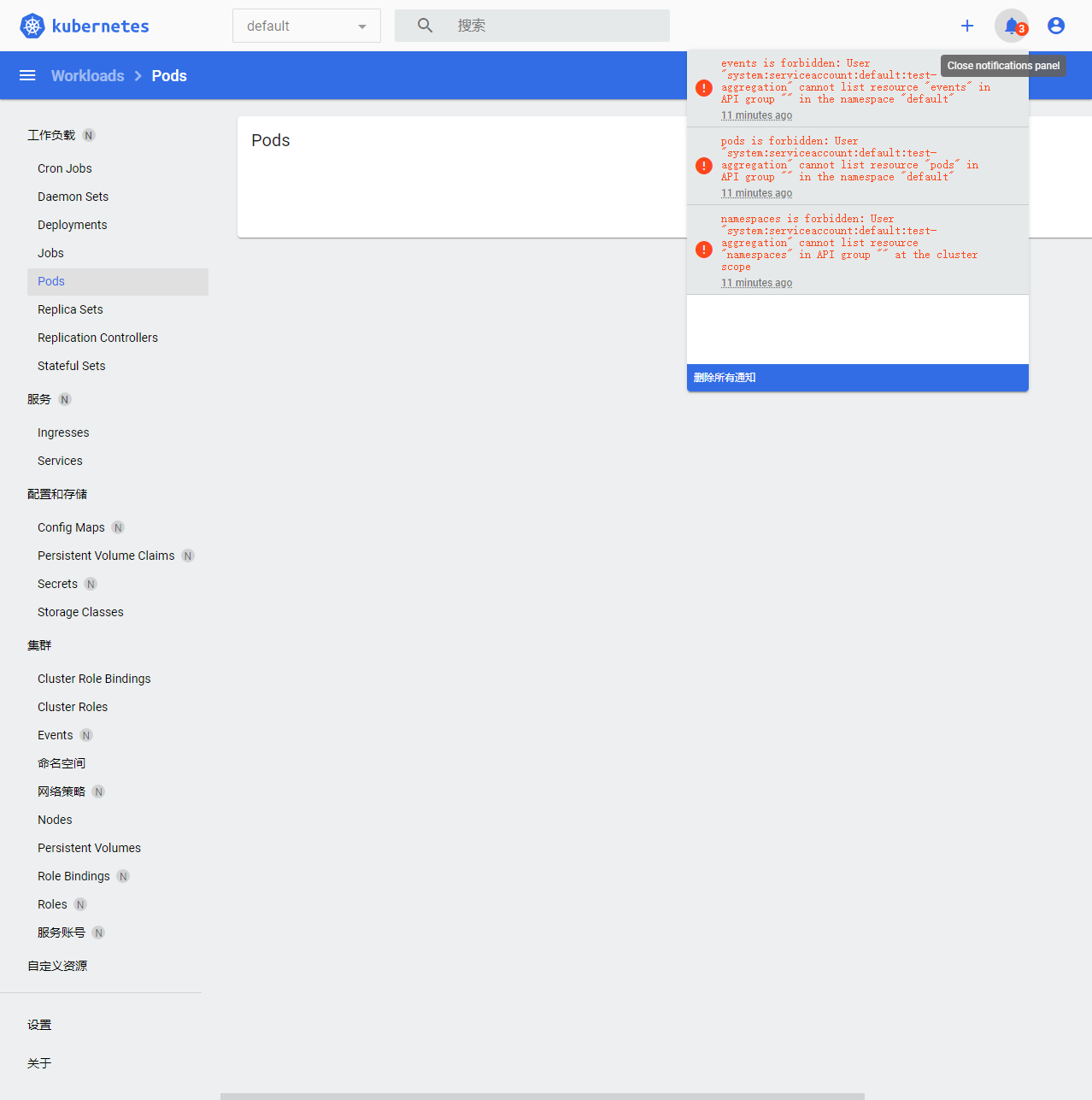
9.新建一个ClusterRole,通过rbac.example.com/aggregate-to-monitoring: "true"标签创建聚合ClusterRole
[root@k8s-master01 study]# vim b-clusterrole.yaml
kind: ClusterRole
apiVersion: rbac.authorization.k8s.io/v1
metadata:
  name: b-aggregation
  labels:
    rbac.example.com/aggregate-to-test-aggregation: "true"
# These rules will be added to the "monitoring" role.
rules:
- apiGroups: [""]
  resources: ["services", "endpoints", "pods","namespaces"]
  verbs: ["get", "list", "watch"]
10.创建一个权限
[root@k8s-master01 study]# kubectl create -f b-clusterrole.yaml
clusterrole.rbac.authorization.k8s.io/b-aggregation created
11.查看权限是否更新,观察到权限已经更改
[root@k8s-master01 study]# kubectl get  -f a-clusterrole.yaml -oyaml
aggregationRule:
  clusterRoleSelectors:
  - matchLabels:
      rbac.example.com/aggregate-to-test-aggregation: "true"
apiVersion: rbac.authorization.k8s.io/v1
kind: ClusterRole
metadata:
  creationTimestamp: "2022-12-11T11:17:43Z"
  name: test-aggregation
  resourceVersion: "64549"
  uid: fda32c93-0897-489f-a51e-ff6c48d2a6ee
rules:
- apiGroups:
  - ""
  resources:
  - services
  - endpoints
  - pods
  - namespaces
  verbs:
  - get
  - list
  - watch
12.在浏览器上刷新进行查看,观察到指定权限可以操作